
- Home
- Defence News
- Defence Appointments
- Defence Manufacturing
- Ministry of Defence
- CAPFsCAPFs
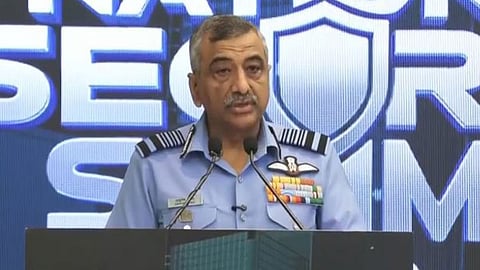
New Delhi: Chief of the Air Staff Air Chief Marshal Ashutosh Dixit has declared that Aatmanirbharta is an operational necessity for India's future combat readiness, warning that the country cannot depend on foreign powers for critical components, software, engines and military supplies during a conflict. Addressing the ANI National Security Summit 3.0 in New Delhi on November 16, he outlined the Indian Air Force's approach to future warfare under its VAYU vision, emphasising control, sustained production and rapid technological adaptation
Follow Defence Watch on LinkedIN
Dixit identified three essential benchmarks for military preparedness: the ability to control critical technologies, sustain operations during prolonged conflicts and adapt faster than adversaries. He argued that access to source code, algorithms, data links, spares and munitions must remain secure and independent of external decisions. Recalling the indigenous development of the Tejas fighter's fly-by-wire flight-control system following the 1998 nuclear tests and subsequent sanctions, he stressed that a capability that another country can switch off during a crisis is not truly owned.
Highlighting lessons from the Russia-Ukraine war and conflicts in West Asia, the Air Chief warned that modern warfare consumes drones, precision weapons and air-defence interceptors at rates that conventional peacetime production may struggle to sustain. He called for domestic production lines capable of rapidly increasing output, deeper MSME supply chains, multiple sources for critical components and stockpiles designed for prolonged warfare. He also highlighted the need for faster technological adaptation, citing the evolution of fibre-optic-guided drones in response to electronic jamming.
Outlining the IAF's operational preparations, Dixit identified four priorities: maintaining immediate operational readiness, expanding production of long-range precision weapons and mass drones, developing AI-enabled command-and-control systems for faster decision-making, and strengthening jointness among the three armed services. He also highlighted the growing importance of cyber, electromagnetic, space and near-space domains, where future conflicts could begin even before conventional military engagements.
The Air Chief cited Operation Sindoor as an example of integrated operations, highlighting coordination between the IAF's Integrated Air Command and Control System (IACCS) and the Army's Akashteer air-defence network. He also referred to the performance of indigenous systems such as Akash and BrahMos, emphasising the operational value of domestic technologies and inter-service integration.
Dixit highlighted India's defence production reaching ₹1.78 lakh crore in FY 2025–26, with exports touching a record ₹38,424 crore. He also pointed to the expansion of indigenous fighter aircraft, missile, helicopter and transport-aircraft programmes. Calling on domestic manufacturers to become technology partners rather than merely equipment vendors, he urged industry to build next-generation capabilities alongside the armed forces. His remarks underlined the IAF's position that technological ownership, industrial endurance and operational readiness must advance together.
(Defence Watch– India’s Defence News centre that places the spotlight on Defence Manufacturing, Defence Technology, Strategy and Military affairs is on Twitter. Follow us here and stay updated.)
