
- Home
- Defence News
- Defence Appointments
- Defence Manufacturing
- Ministry of Defence
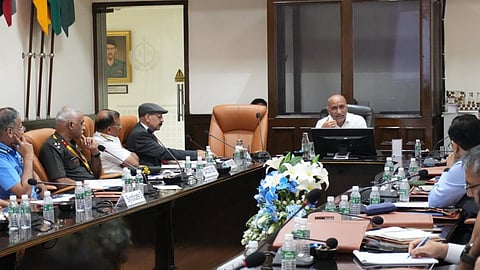
New Delhi: Secretary (Defence Production) Sanjeev Kumar addressed the Combined Operational Review and Evaluation (CORE) Programme at the Manekshaw Centre on September 15, outlining the strategic priorities for strengthening India’s defence capabilities and industrial capacity towards the Viksit Bharat 2047 vision.
Sanjeev Kumar emphasised that Aatmanirbhar Bharat and Make in India will remain the foundation of India’s long-term defence transformation, with the country’s capability-building effort requiring coordinated participation from Defence Public Sector Undertakings (DPSUs), private industry, MSMEs, start-ups, innovators and academia.
Follow Defence Watch on LinkedIN
He highlighted key government initiatives including iDEX, SRIJAN, Defence Industrial Corridors, FDI reforms and defence R&D as important instruments for expanding the domestic defence ecosystem. The emphasis is increasingly shifting from simply producing defence equipment domestically towards developing indigenous technologies, manufacturing capacity and globally competitive products.
A major priority identified was sustained investment in research and development, alongside faster and more flexible procurement mechanisms. Kumar also stressed the importance of skilled human capital, competitive industry and stronger civil-military-industry-academia linkages to convert technological innovation into operational military capabilities.
The approach comes as India’s defence manufacturing sector is expanding rapidly. The country recorded approximately ₹1.8 lakh crore in defence production during FY 2025-26, with DPSUs accounting for around ₹1.29 lakh crore, according to the Defence Ministry.
The government is simultaneously seeking to expand India’s defence export footprint. Recent policy efforts have increasingly focused on enabling private companies, MSMEs and start-ups to enter defence supply chains while encouraging DPSUs to improve technological capability, productivity and global competitiveness.
For India, the significance of the CORE discussions extends beyond industrial output. A larger and technologically stronger domestic defence industry can reduce dependence on foreign supply chains, improve military preparedness during prolonged contingencies and strengthen strategic autonomy.
The focus on R&D, advanced manufacturing and industry-academia collaboration also points towards a broader ambition: moving India from being primarily a major defence equipment buyer to becoming a developer, manufacturer and exporter of increasingly sophisticated military technologies.
With Viksit Bharat 2047 as the long-term objective, the defence-production strategy is therefore increasingly centred on building an ecosystem capable of delivering indigenous technology, scalable manufacturing, resilient supply chains and export-ready defence products—linking industrial growth directly with national security and strategic autonomy.
(Defence Watch– India’s Defence News centre that places the spotlight on Defence Manufacturing, Defence Technology, Strategy and Military affairs is on Twitter. Follow us here and stay updated.)

