
- Home
- Defence News
- Defence Appointments
- Defence Manufacturing
- Ministry of Defence
- CAPFsCAPFs
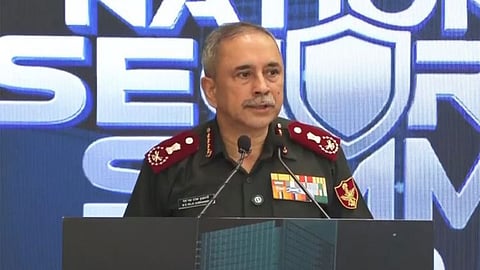
New Delhi: Chief of Defence Staff (CDS) General NS Raja Subramani has called for India to develop reliable and self-reliant space capabilities, warning that dependence on foreign-controlled satellite networks could compromise military operations during conflicts. Addressing the ANI National Security Summit 3.0 in New Delhi on November 16, he cited the disruption of Starlink services during the Russia-Ukraine war as an example of how losing access to external satellite infrastructure can affect battlefield effectiveness.
Follow Defence Watch on LinkedIN
Referring to Ukraine's experience, General Subramani said that when Starlink connectivity was denied or degraded, Ukrainian long-range drones lost their effectiveness. He warned that India's adversaries could similarly attempt to deny the country access to space-based services during a conflict, making independent satellite infrastructure a strategic necessity.
The CDS emphasised that space has become a critical enabler of modern warfare, supporting intelligence, surveillance and reconnaissance (ISR), military communications, precision navigation and timing. He highlighted India's Space-Based Surveillance-3 (SBS-3) programme, stating that its full deployment would significantly strengthen the country's surveillance capabilities. However, he stressed that India must further expand these capabilities to ensure reliable and resilient access to essential space-based services.
General Subramani called for developing domestic space capabilities through both the Indian Space Research Organisation (ISRO) and commercial private-sector players. He also highlighted the importance of indigenous navigation infrastructure, pointing to the successful launch of the NavIC NVS-03 satellite on October 30, 2026. He noted that precision, navigation and timing capabilities are essential for long-range weapons and other military systems, and must remain under India's control.
Beyond space, the CDS identified five priority areas for future military preparedness: space capabilities, algorithmic and data warfare, defence manufacturing, modernisation of legacy equipment and development of skilled human resources. He stressed that domestic industries must move beyond assembling complete systems and develop the ability to manufacture critical components such as sensors, servos and magnetometers, while retaining the intellectual property and technology required for large-scale production.
His remarks underlined India's broader push towards technological sovereignty in defence, where control over critical infrastructure, resilient supply chains and indigenous capabilities will increasingly determine operational independence. The message is clear: India's military preparedness must not depend on access to technologies or networks that external actors can potentially switch off during a crisis.
(Defence Watch– India’s Defence News centre that places the spotlight on Defence Manufacturing, Defence Technology, Strategy and Military affairs is on Twitter. Follow us here and stay updated.)
