
- Home
- Defence News
- Defence Appointments
- Defence Manufacturing
- Ministry of Defence
- CAPFsCAPFs
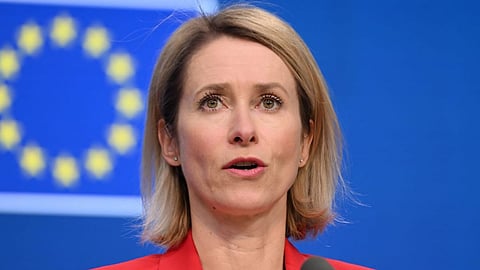
Brussels: The European Union is intensifying efforts to address Ukraine’s growing air-defence shortage, with EU foreign policy chief Kaja Kallas urging countries holding interceptor missiles nearing the end of their shelf life to transfer them to Kyiv.
Kallas made the appeal ahead of an informal meeting of EU defence ministers in Ireland, stressing that air defence remains one of Ukraine’s most urgent military requirements as Russian missile and drone attacks continue to intensify.
The proposal carries a significance that extends beyond the immediate battlefield.
European governments now face a difficult strategic calculation:
How much of their existing air-defence stockpiles can be transferred to Ukraine without weakening their own defensive posture?
Follow Defence Watch on LinkedIN
This dilemma has become increasingly important as Ukraine's demand for interceptors continues to outpace available supplies. European countries have previously been reluctant to release some Patriot interceptor stocks because of concerns over their own air-defence requirements.
Kallas's latest appeal therefore highlights a broader problem facing Europe — the continent needs to simultaneously sustain Ukraine, rebuild its own inventories and expand defence-industrial production.
The issue is not simply about the number of missiles available. Modern air-defence systems depend on a wider ecosystem of launchers, radars, command networks and interceptor production capacity.
Ukraine's experience has also demonstrated how quickly high-end interceptors can be consumed during sustained missile and drone campaigns. At the same time, European defence industries cannot immediately replace stocks at the pace demanded by an active war.
This creates a strategic gap between what Europe wants to provide today and what its defence industry can replace tomorrow.
The debate is increasingly pushing European countries towards greater defence spending, joint procurement and expansion of domestic weapons production.
The EU has also been exploring mechanisms to accelerate procurement and strengthen Europe's defence-industrial base, while Ukraine's participation in European defence initiatives is becoming increasingly important.
The geopolitical message is clear: the Ukraine conflict is no longer only testing battlefield capabilities — it is testing the depth, resilience and industrial capacity of Europe's defence architecture.
For Russia, sustained pressure on Ukraine's air-defence network represents an opportunity to exploit shortages and impose costs on Kyiv and its Western supporters.
For Europe, meanwhile, the challenge is becoming a long-term one: maintaining support for Ukraine while ensuring that NATO's eastern flank does not become vulnerable because European arsenals are being depleted faster than they can be replenished.
Kallas's call to use interceptors approaching the end of their shelf life may provide Ukraine with additional short-term protection, but it also underlines a deeper strategic reality.
If support for Ukraine is to remain sustainable, Europe will need to expand missile production, diversify suppliers, improve joint procurement and build deeper defence-industrial capacity.
The Russia-Ukraine war is therefore becoming a test not only of military alliances, but also of Europe's ability to convert political commitments into long-term defence capability.
(Defence Watch– India’s Defence News centre that places the spotlight on Defence Manufacturing, Defence Technology, Strategy and Military affairs is on Twitter. Follow us here and stay updated.)

