
- Home
- Defence News
- Defence Appointments
- Defence Manufacturing
- Ministry of Defence
- CAPFsCAPFs
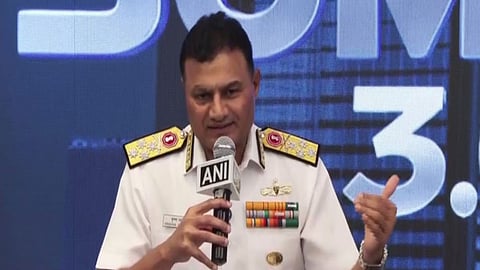
New Delhi: India's maritime security strategy cannot be viewed through the conventional framework of one-front or two-front wars, Chief of the Naval Staff Admiral Krishna Swaminathan said, emphasising that the sea is a continuous operational domain. He asserted that the Indian Navy has robust plans and powerful surface, aerial and underwater capabilities to counter emerging submarine threats.
Follow Defence Watch on LinkedIN
Speaking at the ANI National Security Summit 3.0 in New Delhi on November 16, the Navy Chief said that India closely monitors the military capabilities of neighbouring countries. He also noted that more than 85 percent of Pakistan's military hardware is of Chinese origin, with some Turkish equipment, but stressed that India does not club China and Pakistan into a single strategic category. Their relationships with India are assessed separately at the national level.
Addressing Pakistan's planned acquisition of eight Chinese-built Hangor-class submarines, Admiral Swaminathan acknowledges that the platforms could represent a significant enhancement of the Pakistani Navy's capabilities. He said that India is closely examining the submarines' capabilities and their potential operational implications, while asserting that the Indian Navy is prepared to protect national interests through its submarine fleet, surface ships and naval aviation.
The Navy Chief also highlighted India's familiarity with the operational geography of the Indian Ocean Region and the importance of strengthening its own submarine force. He indicated that India expects to expand its underwater capabilities further, recognising submarine warfare as a critical element of maritime security.
On China's sustained presence in the Indian Ocean, Swaminathan said that Beijing has maintained an almost permanent presence in the region since September or October 2008. He added that India supports freedom of navigation and regards the sea as a global common, welcoming legitimate maritime activity by all countries.
His remarks underlined the Indian Navy's emphasis on maintaining maritime superiority through integrated capabilities rather than treating threats as isolated fronts. With regional submarine fleets expanding, India's surface, underwater and aerial assets will remain central to safeguarding its interests across the Indian Ocean.
(Defence Watch– India’s Defence News centre that places the spotlight on Defence Manufacturing, Defence Technology, Strategy and Military affairs is on Twitter. Follow us here and stay updated.)
