
- Home
- Defence News
- Defence Appointments
- Defence Manufacturing
- Ministry of Defence
- CAPFsCAPFs
New Delhi: India and Russia are reportedly exploring the next phase of their long-standing defence partnership, with discussions around Russia’s S-500 air and missile defence system and Su-57 fifth-generation fighter emerging as potential areas of future cooperation.
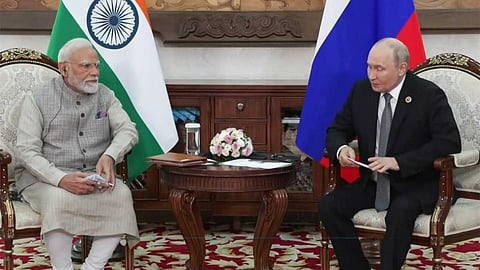
The reported discussions between Prime Minister Narendra Modi and Russian President Vladimir Putin on the sidelines of the SCO Summit come as India evaluates the next generation of capabilities for its air and missile defence architecture.
Follow Defence Watch on LinkedIN
India currently operates the Russian-made S-400 Triumf system, with five squadrons contracted under a deal worth approximately $5.43 billion. Four squadrons have reportedly been delivered, while the fifth is expected by November 2026.
New Delhi is also considering the acquisition of five additional S-400 squadrons, reportedly estimated at more than ₹50,000 crore. Russia has submitted a bid for the proposed procurement, with the possibility of local production also being explored.
The reported interest in the S-500 takes the conversation a step further.
The S-400 is primarily designed for long-range theatre air defence against threats including aircraft, cruise missiles, drones and ballistic missiles. Russia positions the S-500 as a higher-tier system designed to address more demanding threats, including ballistic and hypersonic weapons.
This means the S-500 would potentially complement rather than replace the S-400.
In a layered architecture, the S-400 could continue providing long-range protection against conventional aerial threats, while a higher-tier system such as the S-500 could potentially provide additional protection against advanced ballistic and hypersonic threats.
Why the S-500 matters:
The reported capabilities of the S-500 indicate a significant expansion of the engagement envelope compared with the S-400. The system is reported to have an interception range of around 600 km and an engagement altitude extending towards the near-space boundary.
It is also associated with the ability to counter more advanced threats, including ballistic missiles and potentially hypersonic weapons.
The strategic value lies in developing a multi-layered air and missile defence architecture capable of dealing with increasingly diverse threats — from drones and cruise missiles to ballistic and hypersonic weapons.
The experience of modern conflicts has demonstrated how air defence is increasingly becoming a contest between the sophistication of incoming weapons and the ability of defenders to detect, track and intercept them.
Need of Su-57:
The reported discussions also include Russia's Su-57, adding an entirely different capability dimension to the potential cooperation.
The Su-57 is Russia's fifth-generation stealth fighter and represents Moscow's offering in the advanced combat-aircraft segment.
For India, any future consideration of the aircraft would have to be viewed in the wider context of the Indian Air Force's requirement for modern fighter capacity, indigenous fighter development and long-term force modernisation.
The combination of discussions around the S-500 and Su-57 therefore points towards a broader question: what role can Russia play in India's next generation of high-end defence capabilities?
A changing defence relationship:
For decades, Russia has been one of India's principal defence partners, supplying aircraft, air-defence systems, naval platforms, armour and other military equipment.
However, India's defence procurement landscape is becoming increasingly diversified. India is simultaneously expanding cooperation with the United States, France, Israel and other partners while pushing domestic programmes through organisations such as HAL, DRDO and India's growing private defence industry.
Against this backdrop, future India-Russia cooperation is likely to be judged not only by the hardware being offered, but also by technology access, localisation, industrial cooperation, supply-chain resilience and strategic value. The S-500 and Su-57 discussions, if they progress, could therefore represent more than another procurement cycle.
They could become a test of how India balances its historic defence relationship with Russia against its broader strategy of diversification, technological modernisation and strategic autonomy.
From the S-400 to the S-500 and from fourth-generation fighters towards fifth-generation platforms, India's defence choices are increasingly about building the next layer of capability — not simply replacing the previous one.
(Defence Watch– India’s Defence News centre that places the spotlight on Defence Manufacturing, Defence Technology, Strategy and Military affairs is on Twitter. Follow us here and stay updated.)

